Best Pool Decking Materials for the Houston Bay Area Climate
Your pool deck takes a beating from the Texas sun, Gulf Coast humidity, and seasonal downpours. Here's how the most popular decking materials hold up — and which one is the smartest choice for your backyard.
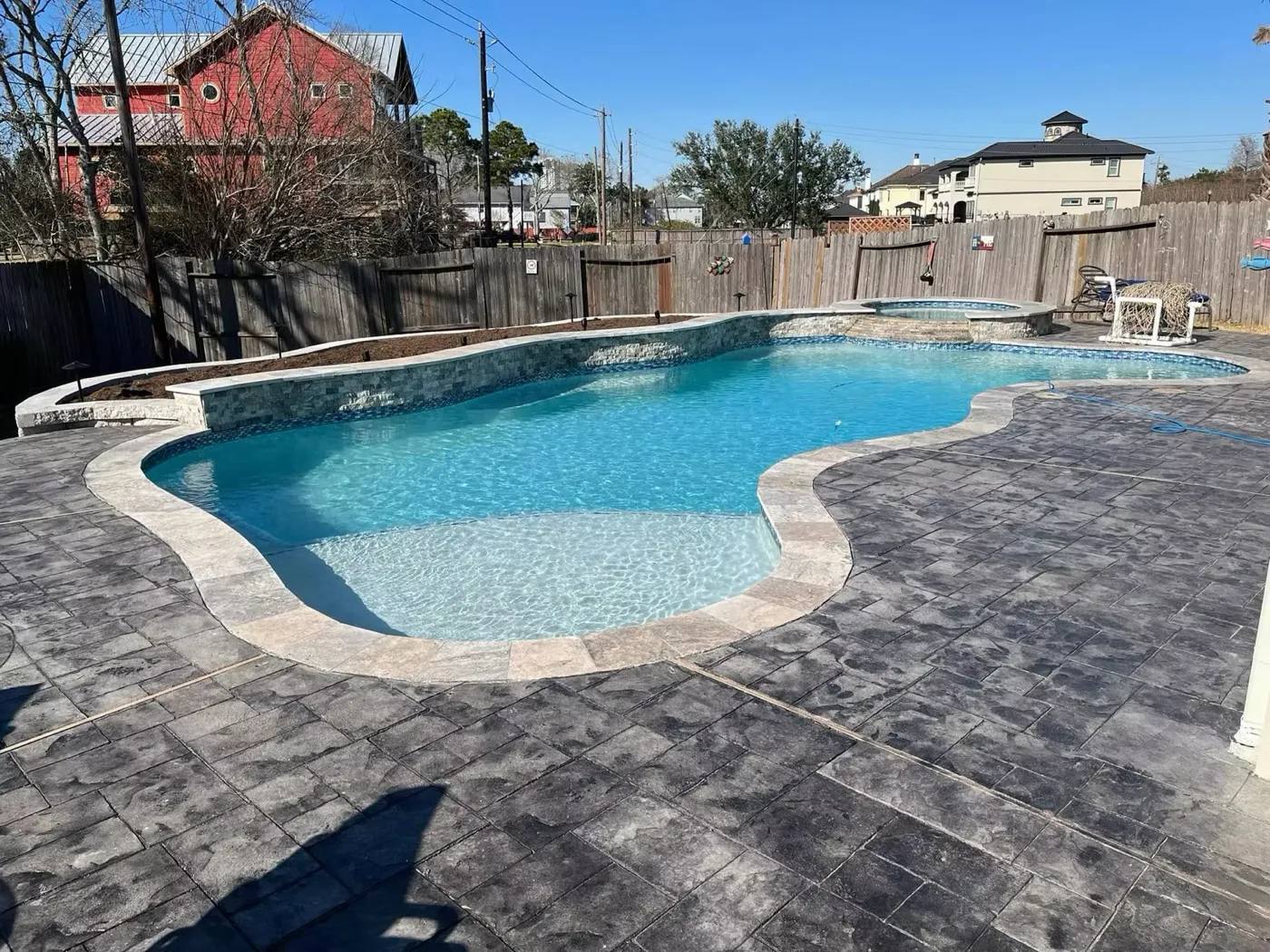
The pool deck is the largest visible surface in most backyard pool designs. It's where you walk barefoot, set up lounge chairs, and host summer gatherings. In the Houston Bay Area — where surface temperatures can exceed 150 degrees F on a July afternoon — choosing the right decking material isn't just an aesthetic decision. It's a comfort and safety decision.
As hardscaping specialists serving League City, Clear Lake, Friendswood, and the surrounding Bay Area, we install all three major decking types. Here's an honest comparison to help you choose.
Stamped Concrete: The Most Popular Choice
Stamped concrete is poured concrete that's textured and colored to mimic natural stone, brick, slate, or flagstone. It's the most common pool decking material in the Houston area — and for good reason.
Why Bay Area Homeowners Choose Stamped Concrete
- Versatile design options — Dozens of patterns and colors available. Simulate the look of travertine, slate, or brick at a fraction of the cost.
- Durable in Gulf Coast weather — Properly sealed stamped concrete handles heavy rain, UV exposure, and the freeze-thaw cycles that occasionally hit the League City area.
- Seamless coverage — No joints or grout lines (other than control joints), which means fewer places for weeds, ants, or water to penetrate.
- Cost-effective — Typically $12-$20 per square foot installed, making it the most budget-friendly option for large deck areas.
What to Watch Out For
- Heat absorption — Dark-colored stamped concrete gets hot in direct Texas sun. Choose lighter colors (cream, sandstone, light gray) to reduce surface temperature by 15-20 degrees.
- Slipperiness when wet — Smooth finishes can be slick after rain or pool splashing. Always request a non-slip texture additive in the sealer — this is non-negotiable for pool decks in our area.
- Cracking over time — League City's clay soils shift seasonally. Proper subgrade preparation and control joints minimize cracking, but hairline cracks are normal and don't affect structural integrity.
- Resealing required — Plan to reseal every 2-3 years to maintain color and protection. This costs $1-$3 per square foot and takes a day.
Cost Range
$12-$20 per square foot installed, depending on pattern complexity and color. A typical 800 sq ft pool deck runs $9,600-$16,000.
Travertine Pavers: The Premium Option
Travertine is a natural limestone that's been quarried and cut into pavers. It's been used around pools in Mediterranean climates for centuries, and it's become increasingly popular in the Houston Bay Area for its beauty and thermal properties.
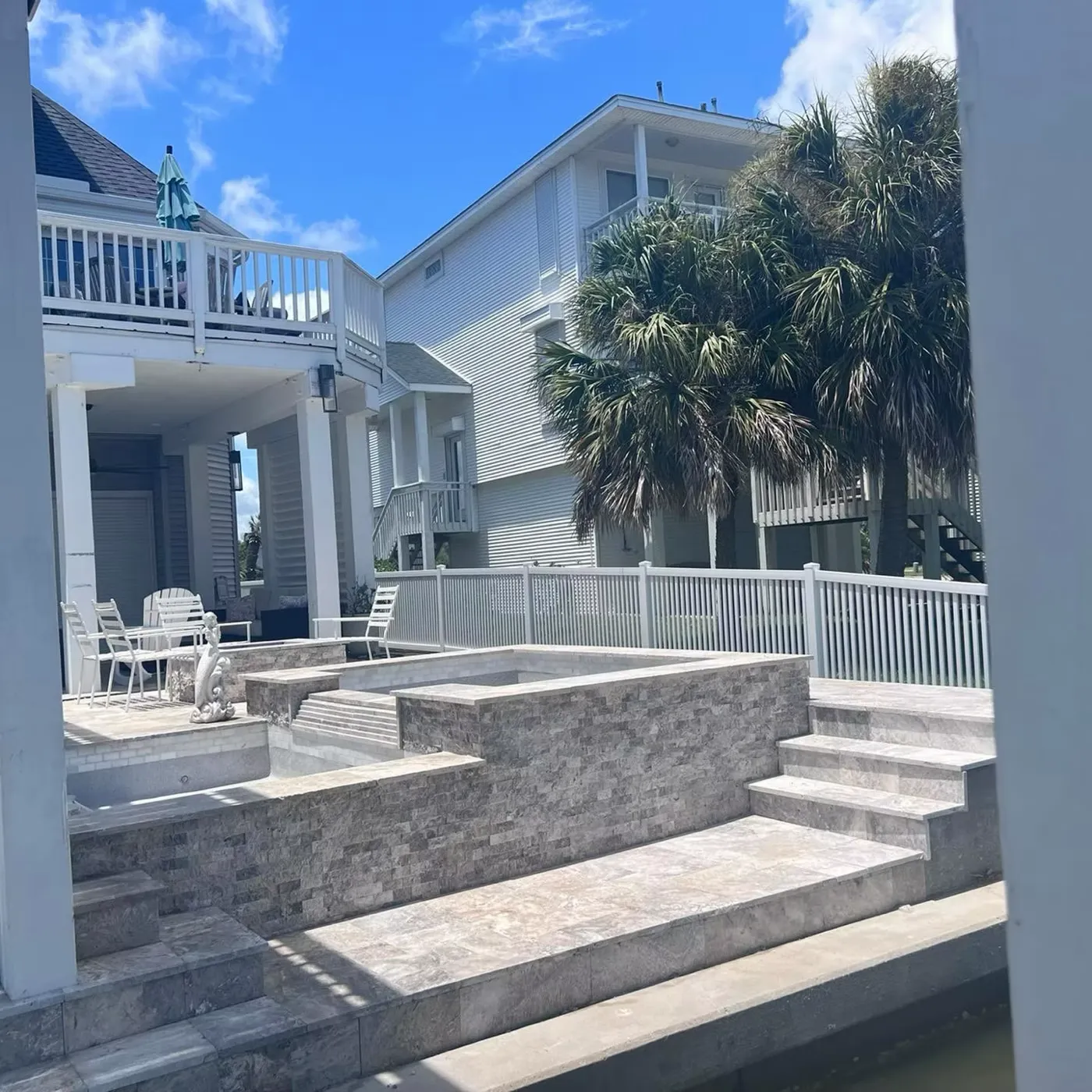
Why Travertine Excels in Our Climate
- Stays cool underfoot — This is travertine's biggest advantage in Texas. The stone's natural porosity and light color keep surface temperatures 20-30 degrees cooler than concrete or dark pavers. On a 100-degree day, travertine is the difference between comfortable and painful.
- Naturally slip-resistant — The stone's surface texture provides excellent grip even when wet. No additives needed.
- Elegant appearance — The natural veining and color variation in travertine creates a high-end look that synthetic materials can't replicate. Popular finishes include tumbled (rustic), honed (smooth), and brushed.
- Individual paver replacement — If a section cracks or stains, you replace individual pavers rather than patching or resurfacing an entire slab. This is a real advantage for long-term maintenance.
- Handles salt and chemicals — Travertine is naturally resistant to pool chemicals, salt chlorine systems, and the mineral-heavy water common in League City.
What to Watch Out For
- Higher cost — Travertine pavers run $20-$35 per square foot installed, making it 2-3x the cost of stamped concrete.
- Requires sealing — Natural stone is porous. Without sealing, travertine absorbs spills, algae, and mineral staining. Seal upon installation and every 2-3 years thereafter.
- Weed growth in joints — The sand-filled joints between pavers can sprout weeds. Polymeric sand (which hardens in the joints) helps prevent this but needs occasional replenishment.
- Color variation — Since it's natural stone, colors vary between batches. Order all your material at once from the same lot to ensure consistency.
- Not DIY-friendly — Proper installation requires a compacted aggregate base, leveling, and precise cutting around curved pool edges. Poor installation leads to shifting and uneven surfaces.
Cost Range
$20-$35 per square foot installed. An 800 sq ft deck runs $16,000-$28,000. Premium French pattern layouts with custom borders cost more.
Kool Deck: The Heat-Reducing Classic
Kool Deck (a brand name from Mortex) is a spray-applied acrylic coating applied over poured concrete. It creates a textured, light-colored surface specifically designed to reduce heat — originally developed for pool decks in the Southwest.
Why Kool Deck Works in the Bay Area
- Excellent heat reduction — Kool Deck's textured surface and light color reflect sunlight rather than absorbing it. Surface temperatures run 20-25 degrees cooler than standard concrete.
- Affordable — At $6-$12 per square foot over existing concrete, Kool Deck is the most budget-friendly decking option. It's also a great solution for resurfacing existing pool decks that have become too hot.
- Good traction — The textured finish provides reliable grip when wet, making it a safe choice for families.
- Fast installation — Can be applied over existing concrete in 1-2 days, with a 24-48 hour cure time before foot traffic.
What to Watch Out For
- Durability concerns — Kool Deck is a coating, not a structural material. In high-traffic areas, the surface can wear down or chip over time. Expect to re-coat sections every 8-12 years.
- Limited color and pattern options — You get a textured, lace-like appearance in a range of earth tones. It doesn't offer the pattern variety of stamped concrete or the natural beauty of travertine.
- Staining — The porous texture can absorb food, drink, and rust stains. Sealing helps but doesn't eliminate the issue entirely.
- Repair visibility — Patched areas are often visible because it's difficult to match the original texture and color exactly. Repairs work best when an entire section is re-coated.
- Dependent on the concrete below — Kool Deck is only as good as the concrete underneath. If the slab cracks, the Kool Deck cracks with it.
Cost Range
$6-$12 per square foot over existing concrete. An 800 sq ft deck runs $4,800-$9,600. New concrete pour with Kool Deck overlay adds another $8-$12 per square foot for the slab.
Quick Comparison Chart
| Factor | Stamped Concrete | Travertine | Kool Deck |
|---|---|---|---|
| Installed cost (per sq ft) | $12-$20 | $20-$35 | $6-$12 |
| Heat resistance | Moderate | Excellent | Very Good |
| Slip resistance | Good (with additive) | Excellent | Very Good |
| Durability | 25-30 years | 30+ years | 8-12 years (re-coat) |
| Maintenance | Reseal every 2-3 yrs | Seal every 2-3 yrs | Re-coat every 8-12 yrs |
| Design variety | High | Moderate | Low |
| Repairability | Difficult (patching visible) | Easy (replace pavers) | Moderate (re-coat sections) |
Our Recommendation for the Houston Bay Area
There's no single "best" material — it depends on your priorities:
- Best overall value: Stamped concrete in a light color with non-slip sealer. It balances cost, durability, and design flexibility for most League City homeowners.
- Best for comfort: Travertine pavers if budget allows. Nothing else keeps your feet as cool on a 100-degree day, and the natural look is unmatched.
- Best for budget or resurfacing: Kool Deck, especially if you already have a concrete deck that's too hot. It solves the heat problem at the lowest cost.
Many of our clients use a combination — travertine on the main lounging area closest to the pool, with stamped concrete on the outer deck and walkways. This gives you premium comfort where you need it most while controlling costs on the larger surface area.
Whatever material you choose, proper installation is critical in our Gulf Coast climate. Drainage slope, subgrade compaction, expansion joints, and sealing all affect how your deck holds up over the years. This is specialized work — not a general contractor job.
Keep reading
Need Help Choosing Your Pool Deck Material?
Contact Aquatic Pools TX for a free backyard consultation. We'll bring samples, discuss your design, and provide an honest quote for your League City or Bay Area pool project.
Get Free ConsultationOr call us directly at 409-986-7600